
What Is Purchasing Power Parity (PPP)? Complete Beginner’s Guide
Learn why exchange rates mislead, how PPP reveals real purchasing power, and how to compare salaries and living standards accurately across countries.
Exchange rates can be dangerously misleading. If you look at a currency converter and see that one US dollar equals 83 Indian rupees, you might assume that an American earning $50,000 per year is far wealthier than an Indian earning 2.5 million rupees. But that assumption collapses the moment you try to buy the same things in both countries. A meal that costs $15 in New York might cost only 200 rupees in Delhi. A one-bedroom apartment that rents for $2,500 in San Francisco might rent for 25,000 rupees in Pune. The nominal exchange rate tells you how many rupees you can get for a dollar. It does not tell you what those rupees can actually buy.
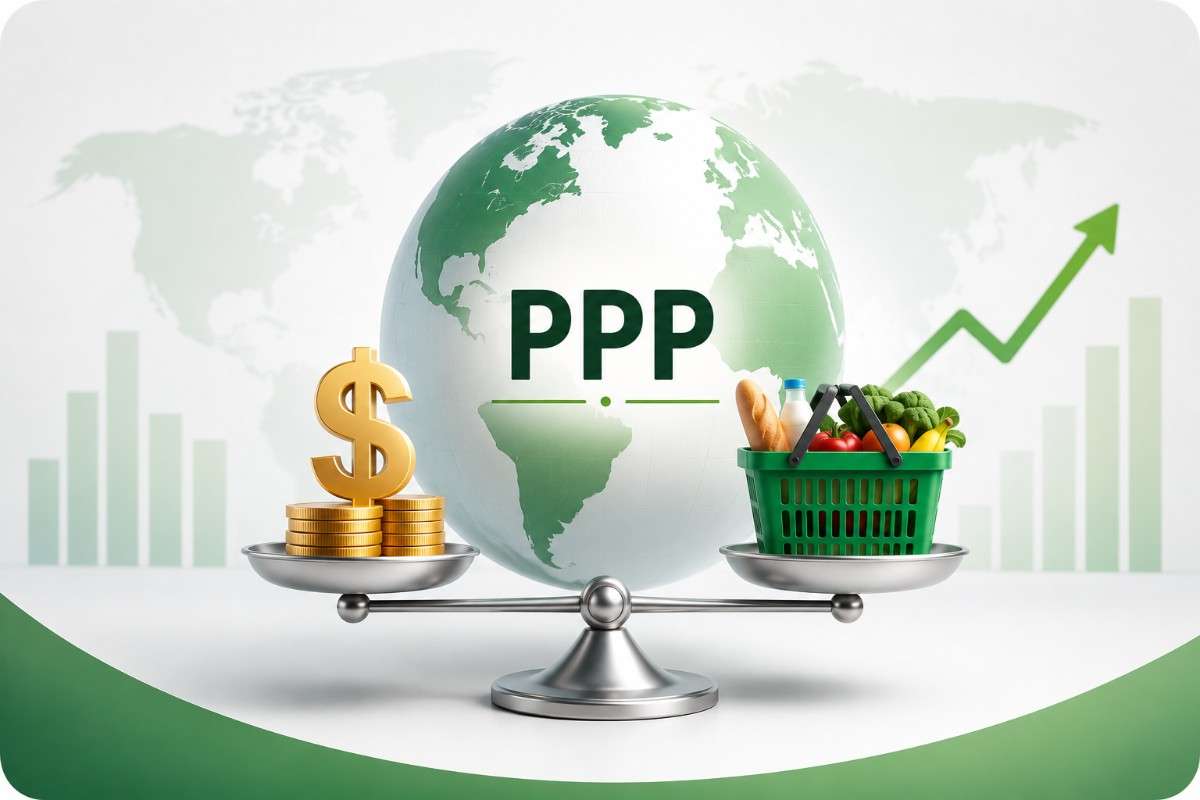
This is precisely why purchasing power parity exists. PPP is an economic theory and measurement tool that compares the real buying power of currencies by looking at what identical goods and services cost in different countries. Instead of asking “how many rupees per dollar?” PPP asks “how many rupees does it take to buy the same basket of goods that one dollar buys in the United States?”
Economists, international organizations, multinational corporations, and increasingly remote workers and digital nomads rely on PPP to make meaningful cross-country comparisons. Without PPP, global poverty statistics would be distorted, GDP rankings would misrepresent economic reality, and salary comparisons across borders would be nearly useless.
If you have ever wondered whether a job offer in another country represents a real raise or a pay cut relative to your current cost of living, you have encountered the exact problem that PPP solves. A salary of $80,000 in Zurich is not the same as $80,000 in Lisbon. A freelance rate of $50 per hour means something entirely different if you live in Bangkok versus London. PPP provides the adjustment factor that makes these comparisons accurate.
This guide covers everything you need to know about purchasing power parity, from the basic definition to the mathematical formula, from the World Bank’s International Comparison Program to practical salary conversion examples. It is built to be the most comprehensive resource on the internet for understanding and applying PPP.
To instantly compare purchasing power between countries, try our PPP Calculator. It converts salaries, compares cost of living, and shows you the real purchasing power of your income in any country using the latest PPP conversion factors.
What Is Purchasing Power Parity?
Purchasing power parity is an economic theory and a measurement framework that states that in an efficient market, identical goods should have the same price when expressed in a common currency, after accounting for exchange rates. In simpler terms, a basket of goods that costs $100 in the United States should theoretically cost the equivalent of $100 in any other country once you convert the local price using the PPP exchange rate rather than the market exchange rate.
The concept dates back to the 16th century, when economists at the School of Salamanca in Spain observed that the influx of gold and silver from the Americas was driving up prices across Europe. They recognized that the value of money was tied to what it could purchase, not to the precious metal content of coins. The modern formulation of PPP was developed by Swedish economist Gustav Cassel in 1918, who proposed it as a method for determining appropriate exchange rates after World War I had disrupted the international monetary system. Cassel argued that currencies should be valued based on their domestic purchasing power rather than on arbitrary or speculative exchange rates.
The economic purpose of PPP is threefold. First, it provides a more accurate way to compare living standards across countries. Second, it offers a long-run equilibrium benchmark for exchange rates. Third, it enables international organizations to make meaningful comparisons of economic output, poverty levels, and income distributions without distortions caused by volatile currency markets.
The Law of One Price
PPP rests on a foundational concept called the Law of One Price. This law states that in the absence of transportation costs, trade barriers, and other frictions, an identical good should sell for the same price in two different locations when prices are expressed in the same currency. If a laptop sells for $1,000 in the United States and the market exchange rate is 1 USD = 0.92 EUR, that same laptop should sell for approximately 920 euros in Germany. If it sells for significantly more or less, arbitrage opportunities exist, and market forces should eventually push prices toward parity.
In practice, the Law of One Price rarely holds perfectly for individual goods due to shipping costs, taxes, tariffs, brand pricing strategies, and local market conditions. However, when applied to a broad basket of goods and services, the principle becomes powerful. Deviations from PPP tend to narrow over time, and the theory provides a robust framework for understanding currency valuation and real living standards.
PPP was created to solve a specific measurement problem. Market exchange rates fluctuate daily based on capital flows, interest rate differentials, speculation, and geopolitical events. These fluctuations can cause a country’s measured GDP to swing wildly in dollar terms even if the actual volume of goods and services produced remains unchanged. PPP exchange rates strip out this volatility by anchoring currency conversion to actual purchasing power, providing a stable and economically meaningful basis for comparison.
How Purchasing Power Parity Works
PPP works by defining a representative basket of goods and services, pricing that basket in each country’s local currency, and then calculating the implicit exchange rate that would make the cost of the basket equal across countries. This PPP exchange rate can then be used to convert incomes, GDP figures, and other monetary values into a common currency for meaningful comparison.
The Basket of Goods Concept
The basket of goods is the heart of PPP methodology. It includes hundreds or even thousands of specific items that represent typical consumption patterns. The basket covers food items such as rice, bread, milk, eggs, meat, fruits, and vegetables. It includes housing costs such as rent, utilities, and maintenance. Transportation items like gasoline, public transit fares, and vehicle prices are part of the basket. Clothing, footwear, healthcare services, education costs, communication services, and recreational goods are all included. The goal is to capture a comprehensive snapshot of what ordinary people spend money on.
International organizations like the World Bank and OECD go to extraordinary lengths to ensure comparability. A “loaf of white bread” must be specified precisely so that the item priced in Tokyo is genuinely comparable to the item priced in Nairobi. Brand specifications, quality adjustments, outlet type, and even the time of year when prices are collected are carefully standardized.
Cost Comparison and Currency Adjustment
Once the basket is priced in local currency for each country, the PPP conversion factor is derived. This factor represents the number of units of local currency required to purchase the same quantity of goods and services that one US dollar buys in the United States. For example, if the basket costs 25,000 rupees in India and $500 in the United States, the PPP conversion factor is 50 rupees per dollar. This means that at PPP, one dollar has the same purchasing power as 50 rupees, even though the market exchange rate might be 83 rupees per dollar.
This PPP conversion factor is then used to adjust incomes. If an Indian worker earns 1,000,000 rupees per year, dividing by the PPP conversion factor of 50 yields a PPP-adjusted income of $20,000. This $20,000 figure represents the equivalent purchasing power in US terms, allowing for a direct comparison with American incomes.
Real-World Examples
India vs USA: The market exchange rate is approximately 1 USD = 83 INR. The PPP conversion factor published by the World Bank for India is around 23 INR per USD. This means the rupee has significantly more purchasing power domestically than the market exchange rate suggests. A software engineer earning 2,500,000 rupees per year in India has a PPP-adjusted salary of approximately $108,695 (using the PPP factor of 23). At the market exchange rate, that same salary appears to be only about $30,120. The PPP-adjusted figure much more accurately reflects the engineer’s actual standard of living.
Nepal vs USA: Nepal’s market exchange rate is approximately 1 USD = 133 NPR. The PPP conversion factor is around 42 NPR per USD. A Nepali professional earning 2,000,000 NPR per year has a PPP-adjusted income of roughly $47,619. At the market exchange rate, the income appears to be only about $15,038. The PPP figure reveals that the Nepali professional’s real purchasing power is more than three times what the raw exchange rate would indicate.
UK vs USA: The market exchange rate hovers around 1 GBP = 1.27 USD. The PPP conversion factor for the UK is approximately 0.70 GBP per USD. A British worker earning £45,000 per year has a PPP-adjusted income of about $64,286. Using the market exchange rate, the same salary converts to approximately $57,150. PPP shows that the British worker’s purchasing power is higher than the exchange rate suggests, reflecting relatively higher UK prices but also indicating that the pound’s market value somewhat understates domestic buying power relative to the dollar.
Use our Purchasing Power Parity Calculator to run similar comparisons for any country pair using the latest available PPP data.
Purchasing Power Parity Formula
The fundamental PPP formula is elegantly simple, though its application requires sophisticated data collection and methodology. The core equation is:
In this formula, Country A is typically the country whose currency you are converting into, and Country B is the reference country, most commonly the United States. The result tells you how many units of Country A’s currency are needed to purchase the same basket of goods that one unit of Country B’s currency purchases in Country B.
Explaining Every Variable
Cost of Basket in Country A: This is the total price, expressed in Country A’s local currency, of a precisely defined basket of goods and services. This basket is constructed to represent a broad range of consumer expenditures, including food, housing, transportation, clothing, healthcare, education, and entertainment. The items must be comparable in quality, quantity, and specification across countries. For example, “1 kilogram of long-grain white rice” or “one visit to a general practitioner for a standard consultation.”
Cost of Basket in Country B: This is the total price of the same basket in the reference country, expressed in that country’s local currency. For most international comparisons, the reference country is the United States and the currency is the US dollar. The basket composition is identical in principle, though some adjustments are made for items that are not commonly consumed in certain countries.
PPP Exchange Rate: The resulting figure is the exchange rate at which purchasing power is equalized. If this PPP rate differs from the market exchange rate, one currency is considered overvalued or undervalued relative to the other in terms of real purchasing power.
Worked Example 1: Simple Two-Item Basket
Consider a simplified basket with only two items: a loaf of bread and a liter of milk.
In the United States, a loaf of bread costs $3.00 and a liter of milk costs $1.20. Total basket cost: $4.20.
In Mexico, an equivalent loaf of bread costs 45 pesos and a liter of milk costs 22 pesos. Total basket cost: 67 pesos.
PPP Exchange Rate = 67 pesos ÷ $4.20 = 15.95 pesos per USD.
If the market exchange rate is 18 pesos per USD, the peso is undervalued relative to PPP. The PPP rate of 15.95 suggests that 15.95 pesos in Mexico buy what $1.00 buys in the US, even though the market requires 18 pesos to get one dollar. The peso’s real purchasing power is higher than the market exchange rate implies.
Worked Example 2: Salary Conversion Using PPP
An engineer in Brazil earns 240,000 Brazilian reais per year. The cost of a representative basket in Brazil is 6,000 reais. The cost of the same basket in the United States is $2,000.
PPP Exchange Rate = 6,000 BRL ÷ $2,000 = 3 BRL per USD.
PPP-Adjusted Salary = 240,000 BRL ÷ 3 = $80,000.
This means the Brazilian engineer’s real purchasing power is equivalent to an American earning $80,000, regardless of what the market exchange rate says.
Worked Example 3: Relative PPP Over Time
Suppose the price level in the UK increases by 10% over five years while the price level in the US increases by 4% over the same period. The initial exchange rate is 1 GBP = 1.30 USD.
According to relative PPP, the pound should depreciate by approximately 6% (the inflation differential) to offset the higher UK inflation. The new PPP-implied exchange rate would be approximately 1 GBP = 1.22 USD. If the market rate remains at 1.30, the pound is overvalued in PPP terms.
To perform salary conversions and purchasing power comparisons without manual calculations, visit our PPP Salary Calculator.
Types of Purchasing Power Parity
PPP is not a single monolithic concept. Economists and statisticians use several distinct variants of PPP, each suited to different analytical purposes. Understanding these types is essential for correctly interpreting PPP data and avoiding common misinterpretations.
Absolute PPP
Absolute PPP is the strictest form of the theory. It states that the exchange rate between two currencies should equal the ratio of the price levels in the two countries. Under absolute PPP, a basket of goods costs exactly the same in both countries when converted at the prevailing exchange rate. This version of PPP is based directly on the Law of One Price applied to an entire price level rather than individual goods. Absolute PPP rarely holds in the short run due to transaction costs, non-tradable goods, and market imperfections, but it serves as a theoretical benchmark for long-run exchange rate determination.
Relative PPP
Relative PPP is a more flexible and empirically useful version of the theory. It states that the percentage change in the exchange rate between two currencies over a given period should equal the difference in inflation rates between the two countries. If Country A experiences 5% inflation and Country B experiences 2% inflation, Country A’s currency should depreciate by approximately 3% against Country B’s currency to maintain purchasing power parity. Relative PPP acknowledges that absolute price levels may differ, but it asserts that exchange rate movements should compensate for inflation differentials over time. This version is widely used in macroeconomic forecasting and currency valuation models.
GDP PPP
GDP PPP refers to gross domestic product converted to international dollars using purchasing power parity exchange rates. An international dollar is a hypothetical currency unit that has the same purchasing power as one US dollar in the United States. When the World Bank reports that China’s GDP at PPP is $30 trillion international dollars, it means that the volume of goods and services produced in China, valued at Chinese prices and converted using PPP rates, is equivalent to what $30 trillion would buy in the United States. GDP PPP is the standard metric for comparing the real size of economies and is used in the World Bank’s global economic rankings, the IMF’s World Economic Outlook, and the CIA World Factbook.
Consumption PPP
Consumption PPP focuses specifically on household consumption expenditure rather than total GDP. It prices a basket of consumer goods and services, excluding investment goods, government spending, and net exports. Consumption PPP is particularly relevant for comparing living standards, calculating poverty lines across countries, and adjusting salaries. The World Bank’s International Comparison Program produces consumption PPP estimates that are used to determine global poverty thresholds, such as the international poverty line of $2.15 per day in 2017 PPP terms.
Income PPP
Income PPP refers to the adjustment of household income or per capita income using PPP conversion factors rather than market exchange rates. PPP-adjusted income figures are used to compare real living standards, assess inequality across countries, and evaluate the size of the global middle class. When you see statistics about “PPP-adjusted GDP per capita,” this is income PPP at the national level. When you use our PPP Conversion Tool to compare salaries, you are applying income PPP at the individual level.
PPP vs Exchange Rate
The distinction between PPP exchange rates and market exchange rates is one of the most important concepts in international economics. These two types of exchange rates serve fundamentally different purposes and produce dramatically different results when used for cross-country comparisons.
| Aspect | PPP Exchange Rate | Market (Nominal) Exchange Rate |
|---|---|---|
| Definition | The rate at which one currency must be converted into another to equalize purchasing power | The rate at which one currency trades for another on foreign exchange markets |
| Determined By | Price levels and cost of goods in each country | Supply and demand, interest rates, capital flows, speculation, central bank policy |
| Volatility | Low; changes slowly over years as price levels shift | High; can fluctuate daily or even hourly |
| Primary Purpose | Comparing real living standards, real GDP, and purchasing power across countries | International trade settlement, currency trading, foreign investment transactions |
| Use Case | Economic research, poverty measurement, salary comparison, GDP rankings | Import/export pricing, foreign exchange trading, travel money conversion |
| Accuracy for Living Standards | High; reflects what people can actually buy with their income | Low; distorted by currency speculation, capital flight, and policy interventions |
| Time Horizon | Long-run equilibrium concept | Short-run market-clearing price |
| Example | India PPP rate: ~23 INR per USD | India market rate: ~83 INR per USD |
The conclusion is clear. Market exchange rates are appropriate for transactions that actually cross borders, such as importing goods or transferring money internationally. PPP exchange rates are appropriate for comparing real economic welfare, living standards, and the actual purchasing power of incomes. Using market rates to compare living standards systematically understates the real income of people in lower-cost countries and overstates the real income of people in higher-cost countries.
PPP vs Cost of Living Index
PPP and cost of living indices are closely related but distinct concepts. Both deal with price level comparisons across locations, but they are constructed differently and used for different analytical purposes.
| Aspect | Purchasing Power Parity (PPP) | Cost of Living Index |
|---|---|---|
| Definition | An exchange rate that equalizes purchasing power between countries | A numerical index comparing the cost of a specific lifestyle or consumption pattern across locations |
| Output Format | Currency conversion rate (e.g., 23 INR per USD) | Index number relative to a base city or country (e.g., New York = 100, London = 85) |
| Scope | National-level comparisons using broad representative baskets | City-level or neighborhood-level comparisons, often tailored to expatriate lifestyles |
| Data Sources | World Bank ICP, OECD, national statistical agencies | Private companies (Mercer, ECA International, Numbeo), crowdsourced data |
| Frequency of Updates | Every 3-6 years for full ICP rounds; annual estimates by IMF/WB | Quarterly or annual updates, some platforms update continuously |
| Primary Use | GDP comparison, poverty measurement, macroeconomic analysis | Expatriate compensation, relocation planning, salary negotiation for international moves |
| Basket Customization | Fixed representative basket based on national consumption patterns | Often customizable to specific lifestyles, family sizes, or consumption preferences |
PPP data is more authoritative for macroeconomic and academic research because it is produced by official statistical agencies using rigorous, standardized methodologies. Cost of living indices are more practical for individual relocation decisions because they can be tailored to specific cities and consumption patterns. Our Salary Comparison Calculator bridges both worlds by using PPP conversion factors alongside cost of living data to give you a complete picture of how your salary translates across borders.
PPP vs Inflation
PPP and inflation are interconnected concepts that measure different aspects of price dynamics. Inflation measures the rate of change in prices within a single country over time, while PPP compares price levels across countries at a single point in time or tracks relative price level changes between countries.
| Aspect | Purchasing Power Parity (PPP) | Inflation |
|---|---|---|
| What It Measures | Price level differences across countries at a point in time | Rate of price change within a country over a period of time |
| Unit of Analysis | Cross-sectional comparison between two or more countries | Time-series comparison within one country |
| Key Metric | PPP conversion factor (currency units per international dollar) | Inflation rate (percentage change in price index) |
| Relationship | Changes in PPP over time are driven by inflation differentials between countries | Inflation differentials drive exchange rate movements under relative PPP theory |
| Policy Relevance | Used to set international poverty lines, compare real GDP, adjust development aid allocations | Used by central banks to set interest rates, guide monetary policy, index wages and benefits |
| Measurement Frequency | Benchmark years every 3-6 years with interpolated annual estimates | Monthly or quarterly consumer price index releases |
The link between PPP and inflation is formalized in the theory of relative PPP. If Country A has persistently higher inflation than Country B, Country A’s currency should depreciate against Country B’s currency over time to maintain purchasing power parity. If the depreciation does not occur, Country A’s currency becomes overvalued in PPP terms, and its exports become less competitive. This relationship is a cornerstone of international macroeconomic analysis and currency forecasting.
PPP vs GDP Per Capita
GDP per capita is the most commonly cited measure of a country’s average economic well-being. But whether GDP per capita is measured at market exchange rates or at PPP makes an enormous difference to the resulting figures and rankings.
| Aspect | GDP Per Capita at PPP | GDP Per Capita at Nominal Exchange Rate |
|---|---|---|
| What It Represents | The real volume of goods and services available per person, adjusted for local price levels | The market value of output per person converted at prevailing exchange rates |
| Best For | Comparing living standards, real economic welfare, productivity in real terms | Measuring international financial power, trade capacity, market size for luxury imports |
| Example: India | ~$9,000 (PPP, international dollars) | ~$2,600 (nominal) |
| Example: Switzerland | ~$78,000 (PPP, international dollars) | ~$100,000 (nominal) |
| Gap Direction for Developing Countries | PPP figure is typically higher than nominal figure | Nominal figure understates real domestic purchasing power |
| Gap Direction for High-Cost Developed Countries | PPP figure may be lower than nominal figure | Nominal figure overstates real domestic purchasing power |
The difference between PPP and nominal GDP per capita can be dramatic. For India, the PPP-adjusted figure is more than three times the nominal figure, reflecting the fact that goods and services in India are much cheaper than in the United States. For Switzerland, the PPP-adjusted figure is lower than the nominal figure, reflecting Switzerland’s high domestic price level. PPP GDP per capita provides a more honest comparison of actual living standards, while nominal GDP per capita better reflects a country’s weight in global financial markets.
PPP vs Nominal GDP
The comparison between PPP GDP and nominal GDP has profound implications for understanding the global economic order. China surpassed the United States in GDP at PPP around 2014, yet in nominal terms the US economy remains larger. This single fact illustrates why the choice of conversion method matters enormously for economic analysis, geopolitical assessments, and investment decisions.
| Aspect | GDP at PPP | Nominal GDP |
|---|---|---|
| Conversion Method | Uses PPP exchange rates based on price level comparisons | Uses market exchange rates prevailing in foreign exchange markets |
| Reflects | Real output volume and domestic purchasing power | Market value of output in internationally traded currency terms |
| China GDP (2024 est.) | ~$35 trillion (international dollars) — largest in the world | ~$18 trillion — second largest |
| India GDP (2024 est.) | ~$14 trillion (international dollars) — third largest | ~$4 trillion — fifth largest |
| United States GDP (2024 est.) | ~$27 trillion (international dollars) — second largest | ~$27 trillion — largest |
| Volatility | Stable; changes gradually with real output and relative price levels | Volatile; affected by exchange rate fluctuations even when real output is unchanged |
| Limitations | Quality adjustments are difficult; non-tradable goods bias; data lags | Ignores differences in domestic purchasing power; penalizes countries with weak currencies |
For assessing real economic size, productive capacity, and the domestic standard of living, GDP at PPP is the superior metric. For assessing a country’s ability to import goods, service foreign debt, or project financial power internationally, nominal GDP is more relevant. Sophisticated analysts use both measures and understand what each one reveals and conceals.
How the World Bank Calculates PPP
The World Bank, through the International Comparison Program (ICP), operates the most comprehensive and authoritative PPP calculation system in the world. The ICP is a global statistical partnership involving national statistical agencies, regional development banks, the OECD, Eurostat, and the IMF. Understanding how the World Bank calculates PPP is essential for anyone who wants to use PPP data with confidence.
The International Comparison Program (ICP)
The ICP was established in 1968 as a joint project between the United Nations Statistical Division and the University of Pennsylvania. It has since evolved into the world’s largest statistical program, with over 200 countries and territories participating in the most recent cycle. The ICP produces benchmark PPP estimates approximately every three to six years, with the 2017 cycle being the most recently completed full round and the 2021 cycle results released in 2024.
Data Collection Process
The ICP data collection process is extraordinarily detailed. National statistical agencies collect prices for thousands of specifically defined products across their countries. These products are organized into basic headings such as “rice,” “men’s footwear,” “physician services,” and “residential rent.” For each basic heading, detailed product specifications ensure that the item priced in Ghana is genuinely comparable to the item priced in Germany. Prices are collected from multiple outlets across different regions within each country to capture geographic variation.
In addition to consumer goods, the ICP collects prices for capital goods, government services, and construction inputs to enable GDP-level PPP calculations. Housing is treated with particular care, using both rental data and owner-occupied housing imputations to capture the full cost of shelter.
Basket Methodology
The ICP uses a sophisticated aggregation methodology rather than a single fixed basket for all countries. Each region develops its own regional product list, and these regional lists are linked through a global core list of products that are priced in all participating countries. This approach acknowledges that consumption patterns vary significantly across regions. A basket that accurately represents consumption in Southeast Asia would look very different from one representing consumption in Northern Europe, and the ICP methodology respects these differences while maintaining global comparability through the core list.
PPP Conversion Factors
The final output of the ICP is a set of PPP conversion factors for each participating country. These factors express the number of local currency units required to purchase the same volume of goods and services that one US dollar purchases in the United States. The conversion factors are published for multiple levels of aggregation, including GDP, household consumption, government consumption, and gross fixed capital formation. The World Bank maintains a publicly accessible database of these conversion factors, updated annually between ICP benchmark years using inflation data and extrapolation techniques.
For authoritative PPP data, the World Bank’s World Development Indicators database and the OECD’s PPP database are the primary reference sources. The IMF also publishes PPP estimates in its World Economic Outlook, incorporating ICP data alongside its own methodologies.
Real-Life Applications of PPP
Purchasing power parity is not merely an academic concept confined to economics textbooks. It has practical, everyday applications that affect personal finance decisions, business strategy, government policy, and global development efforts. Understanding these applications helps explain why PPP data is so valuable and widely used.
Salary Comparison Across Countries
The most direct personal application of PPP is comparing job offers or salaries across countries. A salary of 60,000 euros in Madrid is not directly comparable to a salary of $70,000 in Chicago. Using PPP conversion factors, you can determine the real purchasing power of each offer and make an informed decision about which opportunity provides a higher standard of living. Our PPP Adjusted Salary Calculator automates this comparison for any country pair.
Immigration and Relocation Decisions
People considering permanent relocation or immigration need to understand how their savings, pensions, or expected earnings will translate into real living standards in the destination country. PPP analysis reveals that moving from a high-cost country to a lower-cost country can effectively multiply savings and retirement income, while moving in the opposite direction can erode purchasing power significantly.
Remote Work and Digital Nomad Strategy
The rise of remote work has created a new class of professionals who earn in one currency and spend in another. A software developer earning US dollars while living in Thailand, Mexico, or Portugal can achieve a dramatically higher standard of living than the same salary would provide in the United States. PPP analysis quantifies this “geo-arbitrage” opportunity and helps remote workers choose optimal locations.
International Business and Pricing Strategy
Multinational corporations use PPP data to set appropriate prices for their products in different markets. A product priced at $50 in the United States cannot simply be converted at the market exchange rate and sold for the equivalent in every country. PPP analysis helps companies determine price points that reflect local purchasing power while maintaining profitability. It also informs decisions about where to locate operations, how to structure compensation for international employees, and which markets offer the most attractive growth opportunities.
Economic Research and Policy Analysis
Economists and policy analysts use PPP-adjusted data to study global poverty, inequality, economic convergence, and the effectiveness of development programs. The international poverty line of $2.15 per day is expressed in 2017 PPP terms precisely because PPP ensures that the line represents the same real standard of living across all countries. Without PPP, global poverty comparisons would be meaningless.
GDP Comparisons and Global Rankings
International organizations, investors, and governments use PPP GDP to assess the real size of economies, compare productivity levels, and allocate resources. The G20, the World Bank, the IMF, and the United Nations all rely on PPP-based GDP data for their flagship publications and policy recommendations.
Investment Research
Investment analysts use PPP to assess currency valuations, identify overvalued or undervalued markets, and make long-term asset allocation decisions. The concept of currency fair value is fundamentally tied to PPP. When a currency is significantly overvalued or undervalued relative to its PPP-implied rate, investors may anticipate a reversion toward the mean, creating potential trading or hedging opportunities.
PPP Salary Comparison Examples
Concrete salary comparison examples illustrate the power and practical utility of PPP. The following examples use approximate PPP conversion factors and market exchange rates to demonstrate how dramatically the two methods can differ.
India to USA Salary Comparison
An IT professional in Bangalore earns 3,000,000 Indian rupees per year. At the market exchange rate of 83 INR per USD, this appears to be approximately $36,145 — a modest income by American standards. However, the PPP conversion factor for India is approximately 23 INR per USD. At PPP, the salary converts to approximately $130,435 in international dollars. This means the Bangalore professional enjoys a standard of living roughly equivalent to an American earning over $130,000. The PPP-adjusted figure reveals that the Indian salary provides a comfortable upper-middle-class lifestyle domestically, even though the nominal dollar figure suggests otherwise.
Nepal to USA Salary Comparison
A civil engineer in Kathmandu earns 3,500,000 Nepalese rupees per year. The market exchange rate is approximately 133 NPR per USD, yielding a nominal value of about $26,316. The PPP conversion factor for Nepal is roughly 42 NPR per USD. At PPP, the salary converts to approximately $83,333 in international dollars. The PPP figure is more than three times the nominal figure, accurately reflecting the engineer’s solid professional standing and comfortable lifestyle in the Nepalese context.
UK to USA Salary Comparison
A marketing manager in Manchester earns £50,000 per year. At the market exchange rate of 1 GBP = 1.27 USD, this converts to $63,500. The PPP conversion factor for the UK is approximately 0.70 GBP per USD, yielding a PPP-adjusted salary of about $71,429. In this case, the difference between nominal and PPP-adjusted figures is smaller because the UK is a high-income country with price levels closer to those of the United States. The PPP figure still provides a more accurate reflection of real living standards.
Canada to USA Salary Comparison
A registered nurse in Toronto earns 85,000 Canadian dollars per year. The market exchange rate is approximately 1 CAD = 0.74 USD, yielding a nominal value of $62,900. The PPP conversion factor for Canada is roughly 1.25 CAD per USD. At PPP, the salary converts to approximately $68,000 in international dollars. The moderate difference reflects Canada’s somewhat lower price levels compared to the United States, particularly in healthcare and education.
For customized salary comparisons using the latest PPP data, use the PPP Income Comparison tool on our website.
Advantages of Purchasing Power Parity
PPP offers substantial advantages over market exchange rate-based comparisons for a wide range of economic and personal finance applications. These advantages explain why PPP has become the standard methodology for international welfare comparisons, poverty measurement, and economic development analysis.
- Eliminates exchange rate distortion: Market exchange rates are influenced by speculation, capital flows, interest rate policies, and geopolitical events that have nothing to do with the real purchasing power of domestic incomes. PPP strips away these distortions to reveal the underlying economic reality.
- Enables meaningful living standard comparisons: PPP-adjusted income figures allow for genuine comparisons of how well people live in different countries, accounting for the fact that the same dollar amount buys vastly different quantities of goods and services in different places.
- Provides stable long-run benchmarks: Unlike volatile market exchange rates, PPP conversion factors change slowly over time, reflecting gradual shifts in relative price levels. This stability makes PPP data more reliable for long-term planning and analysis.
- Improves accuracy of global poverty measurement: The World Bank’s international poverty line expressed in PPP terms ensures that the poverty threshold represents a consistent standard of deprivation across all countries, regardless of exchange rate fluctuations.
- Correctly ranks economies by real size: PPP GDP rankings reflect actual production volumes rather than currency valuations, providing a more accurate picture of which economies are truly the largest in real terms.
- Supports fair international compensation: Multinational organizations and NGOs use PPP to set salaries for international staff, ensuring that employees in different locations receive comparable real compensation for comparable work.
- Facilitates informed personal decisions: Individuals considering international relocation, remote work arrangements, or cross-border investments can use PPP to make financially sound choices based on real purchasing power rather than misleading nominal figures.
- Underpins economic convergence analysis: PPP data allows economists to study whether poorer countries are catching up to richer ones in real terms, controlling for price level differences that would otherwise obscure genuine progress.
- Integrates non-tradable sector prices: Market exchange rates primarily reflect prices of internationally traded goods. PPP incorporates the full range of goods and services, including non-tradable items like housing, local transportation, and personal services that dominate household budgets.
Limitations of Purchasing Power Parity
Despite its many advantages, PPP is not without significant limitations. A complete understanding of PPP requires acknowledging these shortcomings and knowing when PPP-based comparisons may be misleading or inappropriate.
Non-Tradable Goods Problem
PPP comparisons are heavily influenced by goods and services that cannot be traded internationally. Haircuts, restaurant meals, housing, and local transportation are typically cheaper in lower-income countries because they rely on local labor and cannot be exported. This systematically widens the gap between PPP and market exchange rates for developing countries. Critics argue that PPP overstates the real welfare of people in these countries because the cheapness of non-tradable services partly reflects low wages rather than genuine abundance.
Taxes and Government Services
PPP comparisons struggle to account for differences in the quality and availability of government-provided services. Two countries may have similar PPP-adjusted incomes, but if one provides universal healthcare and free education while the other does not, the actual standard of living may differ substantially in ways that PPP does not capture.
Transportation Costs and Geographic Barriers
The Law of One Price assumes frictionless trade, but in reality, transportation costs, tariffs, and non-tariff barriers prevent price equalization. Island nations, landlocked countries, and remote regions face systematically higher prices for imported goods, and PPP adjustments may not fully account for these structural cost disadvantages.
Data Lag and Frequency
Full ICP benchmark PPP estimates are produced only every three to six years. Annual PPP estimates published by the World Bank and IMF rely on extrapolation using inflation data, which introduces uncertainty. For rapidly changing economies, the PPP figures available at any given time may already be outdated.
Market Imperfections
PPP theory assumes competitive markets, but in many countries, monopolies, price controls, subsidies, and informal economic activity distort prices. These market imperfections weaken the theoretical foundation of PPP and reduce the reliability of PPP-based comparisons.
Quality Adjustment Challenges
Ensuring that goods priced in different countries are truly comparable in quality is extremely difficult. A “doctor’s visit” may involve very different levels of expertise, technology, and care quality across countries. PPP methodologies attempt to adjust for quality differences, but these adjustments are inherently imperfect and introduce subjective judgment into the calculations.
Consumption Pattern Differences
People in different countries consume different baskets of goods. The ICP addresses this through regional product lists and sophisticated aggregation, but the fundamental challenge remains. A basket that accurately represents consumption in Norway may be largely irrelevant in Nigeria, and vice versa. The choice of weights and aggregation methods can significantly influence the resulting PPP estimates.
Big Mac Index vs PPP
The Big Mac Index, created by The Economist magazine in 1986, is the most famous popular application of purchasing power parity theory. It uses the price of a McDonald’s Big Mac burger as a simplified proxy for the broader basket of goods used in official PPP calculations.
| Aspect | Big Mac Index | Official PPP (World Bank ICP) |
|---|---|---|
| Basket Composition | A single product: the Big Mac burger | Thousands of products across all expenditure categories |
| Purpose | Pedagogical tool to explain currency valuation; lighthearted guide to overvaluation and undervaluation | Serious statistical framework for GDP comparison, poverty measurement, and economic analysis |
| Accuracy | Moderate; useful for rough illustrations but too narrow for serious analysis | High; rigorous methodology with quality adjustments and comprehensive coverage |
| Data Collection | McDonald’s menu prices collected by The Economist correspondents | Systematic price surveys by national statistical agencies following ICP protocols |
| Frequency | Updated twice per year | Benchmark estimates every 3-6 years with annual extrapolations |
| Coverage | Limited to countries with McDonald’s restaurants (approximately 55 countries) | Over 200 countries and territories in the most recent ICP cycle |
| Tradability | Non-tradable product; heavily influenced by local labor, rent, and ingredient costs | Mix of tradable and non-tradable goods and services |
| Academic Acceptance | Limited; primarily a teaching and media tool | High; used by the World Bank, IMF, OECD, and academic researchers worldwide |
The Big Mac Index and official PPP are complementary rather than competing concepts. The Big Mac Index makes the abstract idea of PPP tangible and accessible to a broad audience. It illustrates the core principle that identical goods should cost the same across countries when properly measured. However, no serious economic analysis would rely on a single-product index for policy decisions or academic research. Official PPP data from the World Bank and OECD remains the gold standard for international price level comparisons. For accurate purchasing power comparisons, use our PPP Calculator which is grounded in official ICP data rather than single-product proxies.
Common Myths About Purchasing Power Parity
Misconceptions about PPP are widespread, even among otherwise financially literate individuals. Dispelling these myths is essential for using PPP data correctly and avoiding costly analytical errors.
- Myth: PPP is the “correct” exchange rate. Reality: PPP is not an exchange rate that should prevail in currency markets. It is an analytical tool for comparing purchasing power across countries. Market exchange rates serve different purposes and are not “wrong” just because they differ from PPP rates.
- Myth: PPP-adjusted salary tells you exactly how much money you need in another country. Reality: PPP adjustments provide a broad comparison of average purchasing power. Individual experiences vary based on lifestyle, consumption patterns, and location within a country.
- Myth: A higher PPP GDP automatically means a higher standard of living. Reality: PPP GDP is a measure of total economic output, not distribution. A country can have a large PPP GDP but extreme inequality, meaning the average person may not experience the purchasing power the aggregate figure suggests.
- Myth: PPP eliminates all distortions from international comparisons. Reality: PPP addresses exchange rate distortions but introduces its own methodological challenges, including quality adjustments, basket representativeness, and data timeliness issues.
- Myth: The Big Mac Index is an accurate PPP measure. Reality: The Big Mac Index is a simplified illustration, not a rigorous PPP measure. It uses a single non-tradable product and should not be used for serious analysis.
- Myth: PPP rates are updated monthly or quarterly like market exchange rates. Reality: Full PPP benchmarks are produced only every few years. Annual estimates are extrapolations and carry uncertainty.
- Myth: If your salary converted at PPP is higher, you will save more money living abroad. Reality: Savings potential depends on actual spending patterns and whether you spend primarily in the local economy or on imported goods priced at market exchange rates.
- Myth: PPP is only relevant for developing countries. Reality: PPP adjustments matter for all countries. Even among high-income countries, price level differences are significant. Switzerland, Norway, and Japan have much higher price levels than Portugal, Spain, or South Korea.
- Myth: PPP conversion factors are the same for all types of expenditure. Reality: The ICP produces separate PPP conversion factors for household consumption, government spending, and investment. The appropriate factor depends on the specific comparison being made.
- Myth: PPP proves that market exchange rates are manipulated or artificial. Reality: PPP differences primarily reflect the lower cost of non-tradable goods and services in countries with lower average wages. This is a structural economic reality, not evidence of currency manipulation.
- Myth: Once you adjust for PPP, all countries look equally wealthy. Reality: Even after PPP adjustment, enormous differences in living standards persist. The poorest countries have PPP-adjusted GDP per capita figures that are still a tiny fraction of those in wealthy nations.
- Myth: PPP is an outdated concept from the 20th century. Reality: PPP methodology has been continuously refined and improved. The ICP’s 2021 cycle incorporated significant methodological advances, including better treatment of digital products, housing, and quality adjustments.
Frequently Asked Questions About Purchasing Power Parity
What is purchasing power parity in simple terms?
Purchasing power parity is a way to compare the real value of money between countries by looking at what the same goods and services actually cost. Instead of using the currency exchange rate you see on the news, PPP asks: “How much local currency does it take to buy what one US dollar buys in America?” This gives a truer picture of how far your money goes in different places.
How do you calculate purchasing power parity?
PPP is calculated by pricing a representative basket of goods and services in two different countries and dividing one by the other. The formula is: PPP Exchange Rate = Cost of Basket in Country A ÷ Cost of Basket in Country B. For example, if a basket costs 23,000 rupees in India and $1,000 in the US, the PPP exchange rate is 23 rupees per dollar.
What is the difference between PPP and market exchange rate?
The market exchange rate is the price at which currencies trade on foreign exchange markets, driven by supply and demand. The PPP exchange rate is calculated based on the relative cost of goods and services in each country. Market rates can be volatile and are influenced by speculation; PPP rates are stable and reflect actual purchasing power.
Why do economists use PPP instead of nominal exchange rates?
Economists use PPP because nominal exchange rates do not reflect differences in domestic price levels. A country with a weak currency may appear much poorer in nominal dollar terms than it actually is once you account for the lower cost of living. PPP corrects for this and allows meaningful comparisons of real living standards.
What is a PPP calculator used for?
A PPP calculator converts salaries, incomes, or other monetary amounts between countries using purchasing power parity exchange rates rather than market exchange rates. It shows you how much money you would need in another country to maintain the same standard of living you have now. You can use our PPP Calculator to perform these conversions instantly.
What is GDP at purchasing power parity?
GDP at PPP is a country’s gross domestic product converted to international dollars using PPP exchange rates. It reflects the real volume of goods and services produced, stripped of exchange rate distortions. China’s GDP at PPP is larger than that of the United States, even though its nominal GDP is smaller, because goods and services are cheaper to produce domestically in China.
How often are PPP rates updated?
Full PPP benchmarks are published by the World Bank’s International Comparison Program approximately every three to six years. Between benchmark years, the World Bank and IMF produce annual PPP estimates by extrapolating from the most recent benchmark using inflation data from each country.
Is the Big Mac Index the same as PPP?
No. The Big Mac Index is a simplified illustration of PPP using a single product. Official PPP is calculated using thousands of products across all categories of expenditure. The Big Mac Index is useful for teaching and for getting a rough sense of currency valuation, but it is not a substitute for official PPP data.
What are the limitations of PPP?
PPP has several limitations. It struggles with quality differences between countries, relies on data that may be several years old, cannot fully account for differences in government services, and is influenced by the composition of the basket of goods chosen. PPP is a powerful tool but should be used with awareness of its constraints.
How does PPP help with salary comparisons?
PPP helps with salary comparisons by converting incomes into a common currency at a rate that reflects real purchasing power. A salary of 2 million rupees in India converted at the market exchange rate looks like about $24,000, but at PPP it represents roughly $87,000 in real purchasing power. This reveals that the Indian salary actually provides a comparable or better lifestyle than a nominally higher salary in a more expensive country.
What is the Law of One Price?
The Law of One Price states that in an efficient market, identical goods should sell for the same price when expressed in a common currency. It is the theoretical foundation of PPP. If the Law of One Price held perfectly, PPP exchange rates and market exchange rates would be identical.
What is relative PPP?
Relative PPP states that the change in the exchange rate between two currencies over time should equal the difference in their inflation rates. If one country has higher inflation than another, its currency should depreciate to maintain purchasing power parity. Relative PPP is more empirically useful than absolute PPP, which rarely holds in practice.
Which organization produces the most authoritative PPP data?
The World Bank, through the International Comparison Program, produces the most comprehensive and authoritative PPP data. The OECD produces PPP data for its member countries, and the IMF publishes PPP estimates in its World Economic Outlook. All three organizations are considered authoritative sources.
Can PPP be used to predict future exchange rates?
PPP can provide a long-run anchor for exchange rate forecasts, but it is not a reliable short-term predictor. Currencies can deviate from PPP-implied rates for extended periods due to capital flows, interest rate differentials, and market sentiment. However, over very long time horizons, exchange rates do tend to move toward PPP-implied levels.
What is the difference between absolute PPP and relative PPP?
Absolute PPP asserts that the exchange rate should equal the ratio of price levels between two countries. Relative PPP asserts that changes in the exchange rate should equal the difference in inflation rates. Absolute PPP is a stronger, more restrictive condition that rarely holds. Relative PPP is more flexible and empirically realistic.
How does the World Bank ensure quality comparability in PPP calculations?
The World Bank uses detailed product specifications, regional product lists, and rigorous quality adjustment procedures. National statistical agencies are trained in ICP methodology, and products are defined with precise characteristics to ensure that a “kilogram of white rice” or a “standard doctor’s consultation” is genuinely comparable across countries.
Why is India’s PPP conversion factor so different from its market exchange rate?
India’s PPP conversion factor (approximately 23 rupees per dollar) is much lower than its market exchange rate (approximately 83 rupees per dollar) because goods and services in India are substantially cheaper than in the United States. Non-tradable services like housing, domestic help, and local transportation are particularly inexpensive in India, pulling the overall price level down relative to the US.
What is an international dollar?
An international dollar is a hypothetical currency unit that has the same purchasing power as one US dollar in the United States. It is used in PPP-adjusted economic statistics to express values in a common, purchasing-power-equivalent unit. When you see “GDP per capita of $15,000 in international dollars,” it means the country’s output per person can buy what $15,000 would buy in the United States.
Does PPP affect cryptocurrency or digital assets?
PPP does not directly affect cryptocurrencies, which are global digital assets not tied to any single country’s price level. However, the purchasing power of cryptocurrency holdings for an individual depends on where they live and spend. A bitcoin holder in Argentina experiences different real purchasing power than a bitcoin holder in Switzerland, and PPP analysis helps quantify this difference.
How accurate are online PPP calculators?
The accuracy of an online PPP calculator depends on the data source it uses. Calculators that rely on official World Bank ICP data or OECD PPP data are highly reliable for broad country-level comparisons. Calculators using crowdsourced or unofficial data may be less accurate. Our PPP Calculator uses the latest official PPP conversion factors to ensure accuracy.
What is the relationship between PPP and the Human Development Index?
The Human Development Index uses PPP-adjusted GDP per capita as one of its three dimensions alongside life expectancy and education. PPP adjustment ensures that the income component of the HDI reflects real purchasing power and living standards rather than nominal income distorted by exchange rates.
Can PPP be used for historical comparisons?
Yes, but with caution. Historical PPP data is available from the Maddison Project Database and other historical economic data sources. However, the further back in time you go, the more significant the methodological challenges become, including changes in consumption patterns, product availability, and data quality.
What is the ICP 2021 cycle?
The ICP 2021 cycle is the most recent complete round of the International Comparison Program, with results released in 2024. It covers over 200 countries and territories and incorporates methodological improvements in areas such as digital product pricing, housing cost measurement, and treatment of quality differences. The 2021 cycle provides the most up-to-date official PPP benchmarks available.
How does PPP relate to the Sustainable Development Goals?
Several Sustainable Development Goal indicators rely on PPP-adjusted data, including the global poverty rate (SDG 1), GDP per capita growth (SDG 8), and resource efficiency metrics. PPP ensures that these indicators are measured consistently across countries, enabling meaningful tracking of global progress toward the SDGs.
Is PPP useful for small business owners?
Yes. Small business owners considering international expansion, sourcing products from abroad, or hiring remote workers in other countries can use PPP to understand real costs and set appropriate pricing and compensation. PPP analysis helps small businesses make informed decisions about which markets to enter and how to structure their international operations.
Where can I find official PPP data?
Official PPP data is available from the World Bank’s World Development Indicators database, the OECD Statistics portal, the IMF’s World Economic Outlook database, and the ICP website. For quick, user-friendly PPP conversions, you can also use our PPP Calculator which incorporates official data sources.
Our PPP Calculator uses the latest official conversion factors from the World Bank and OECD to give you accurate, real-time comparisons of salaries, cost of living, and real purchasing power across over 190 countries. Whether you are evaluating a job offer abroad, planning a relocation, or simply curious about how far your money would go in another country, the calculator provides instant, reliable results grounded in authoritative PPP data.